


Page 41 - Cape-Camera-July-August-2021
P. 41
Cape Camera                                                                                                                                                               July/August 2021


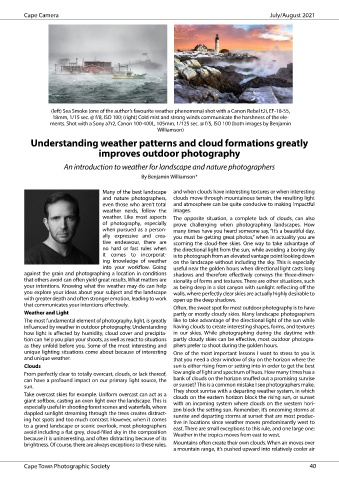
                   (left) Sea Smoke (one of the author’s favourite weather phenomena) shot with a Canon Rebel t2i, EF-18-55,
                   18mm, 1/15 sec. @ f/8, ISO 100; (right) Cold mist and strong winds communicate the harshness of the ele-
                   ments. Shot with a Sony a7r2, Canon 100-400L, 105mm, 1/125 sec. @ f/5, ISO 100 (both images by Benjamin
                                                        Williamson)
            Understanding weather patterns and cloud formations greatly
                                    improves outdoor photography


                       An introduction to weather for landscape and nature photographers
                                                   By Benjamin Williamson*

                                     Many of the best landscape   and when clouds have interesting textures or when interesting
                                     and nature photographers,   clouds move through mountainous terrain, the resulting light
                                     even those who aren’t total   and atmosphere can be quite conducive to making impactful
                                     weather nerds, follow the   images.
                                     weather. Like most aspects   The opposite situation, a complete lack of clouds, can also
                                     of photography, especially   prove challenging when photographing landscapes. How
                                     when pursued as a person-  many times have you heard someone say, “It’s a beautiful day,
                                     ally expressive and crea-  you must be getting great photos,” when in actuality you are
                                     tive endeavour, there are   scorning the cloud-free skies. One way to take advantage of
                                     no hard or fast rules when   the directional light from the sun, while avoiding a boring sky
                                     it comes to incorporat-  is to photograph from an elevated vantage point looking down
                                     ing knowledge of weather   on the landscape without including the sky. This is especially
                                     into your workflow. Going   useful near the golden hours when directional light casts long
          against the grain and photographing a location in conditions   shadows and therefore effectively conveys the three-dimen-
          that others avoid can often yield great results. What matters are   sionality of forms and textures. There are other situations, such
          your intentions. Knowing what the weather may do can help   as being deep in a slot canyon with sunlight reflecting off the
          you explore your ideas about your subject and the landscape   walls, where perfectly clear skies are actually highly desirable to
          with greater depth and often stronger emotion, leading to work   open up the deep shadows.
          that communicates your intentions effectively.      Often, the sweet spot for most outdoor photography is to have
          Weather and Light                                   partly or mostly cloudy skies. Many landscape photographers
          The most fundamental element of photography, light, is greatly   like to take advantage of the directional light of the sun while
          influenced by weather in outdoor photography. Understanding   having clouds to create interesting shapes, forms, and textures
          how light is affected by humidity, cloud cover and precipita-  in our skies.  While photographing during the daytime with
          tion can help you plan your shoots, as well as react to situations   partly cloudy skies can be effective, most outdoor photogra-
          as they unfold before you. Some of the most interesting and   phers prefer to shoot during the golden hours.
          unique lighting situations come about because of interesting   One of the most important lessons I want to stress to you is
          and unique weather.                                 that you need a clear window of sky on the horizon where the
          Clouds                                              sun is either rising from or setting into in order to get the best
          From perfectly clear to totally overcast, clouds, or lack thereof,   low angle of light and spectrum of hues. How many times has a
          can have a profound impact on our primary light source, the   bank of clouds on the horizon snuffed out a promising sunrise
          sun.                                                or sunset? This is a common mistake I see photographers make.
          Take overcast skies for example. Uniform overcast can act as a   They shoot sunrise with a departing weather system, in which
                                                              clouds on the eastern horizon block the rising sun, or sunset
          giant softbox, casting an even light over the landscape. This is   with an incoming system where clouds on the western hori-
          especially useful in shooting forest scenes and waterfalls, where   zon block the setting sun. Remember, it’s oncoming storms at
          dappled sunlight streaming through the trees creates distract-  sunrise and departing storms at sunset that are most produc-
          ing hot spots and too much contrast. However, when it comes   tive in locations since weather moves predominantly west to
          to a grand landscape or scenic overlook, most photographers   east. There are small exceptions to this rule, and one large one:
          avoid including a flat grey, cloud-filled sky in the composition   Weather in the tropics moves from east to west.
          because it is uninteresting, and often distracting because of its
          brightness. Of course, there are always exceptions to these rules,   Mountains often create their own clouds. When air moves over
                                                              a mountain range, it’s pushed upward into relatively cooler air

          Cape Town Photographic Society                                                                                                                                                                                                                  40

