


Page 41 - Cape-Camera-March-April-2021
P. 41
March/April 2021                                                                                                                                                               Cape Camera

          shutter speeds. Mirrorless cameras can help with this as well be-
          cause there is no movement or slap of the mirror that an SLR has,
          and mashing the camera to your face or your body can keep the
          camera more stable. Holding it against a lamp post or tree or on
          top of a bench works too, assuming it doesn’t compromise your
          composition. You could also use a tripod, of course.


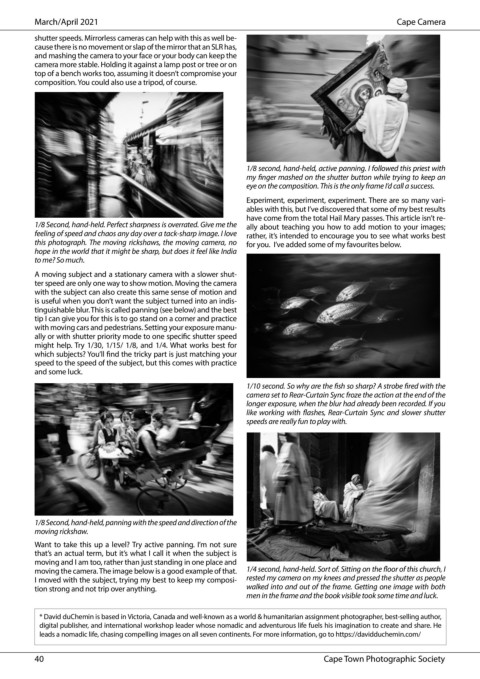
                                                              1/8 second, hand-held, active panning. I followed this priest with
                                                              my finger mashed on the shutter button while trying to keep an
                                                              eye on the composition. This is the only frame I’d call a success.
                                                              Experiment, experiment, experiment. There are so many vari-
                                                              ables with this, but I’ve discovered that some of my best results
                                                              have come from the total Hail Mary passes. This article isn’t re-
          1/8 Second, hand-held. Perfect sharpness is overrated. Give me the   ally about teaching you how to add motion to your images;
          feeling of speed and chaos any day over a tack-sharp image. I love   rather, it’s intended to encourage you to see what works best
          this photograph. The moving rickshaws, the moving camera, no   for you.  I’ve added some of my favourites below.
          hope in the world that it might be sharp, but does it feel like India
          to me? So much.
          A moving subject and a stationary camera with a slower shut-
          ter speed are only one way to show motion. Moving the camera
          with the subject can also create this same sense of motion and
          is useful when you don’t want the subject turned into an indis-
          tinguishable blur. This is called panning (see below) and the best
          tip I can give you for this is to go stand on a corner and practice
          with moving cars and pedestrians. Setting your exposure manu-
          ally or with shutter priority mode to one specific shutter speed
          might help. Try 1/30, 1/15/ 1/8, and 1/4. What works best for
          which subjects? You’ll find the tricky part is just matching your
          speed to the speed of the subject, but this comes with practice
          and some luck.
                                                              1/10 second. So why are the fish so sharp? A strobe fired with the
                                                              camera set to Rear-Curtain Sync froze the action at the end of the
                                                              longer exposure, when the blur had already been recorded. If you
                                                              like working with flashes, Rear-Curtain Sync and slower shutter
                                                              speeds are really fun to play with.


          1/8 Second, hand-held, panning with the speed and direction of the
          moving rickshaw.
          Want to take this up a level? Try active panning. I’m not sure
          that’s an actual term, but it’s what I call it when the subject is
          moving and I am too, rather than just standing in one place and
          moving the camera. The image below is a good example of that.   1/4 second, hand-held. Sort of. Sitting on the floor of this church, I
          I moved with the subject, trying my best to keep my composi-  rested my camera on my knees and pressed the shutter as people
          tion strong and not trip over anything.             walked into and out of the frame. Getting one image with both
                                                              men in the frame and the book visible took some time and luck.

           * David duChemin is based in Victoria, Canada and well-known as a world & humanitarian assignment photographer, best-selling author,
           digital publisher, and international workshop leader whose nomadic and adventurous life fuels his imagination to create and share. He
           leads a nomadic life, chasing compelling images on all seven continents. For more information, go to https://davidduchemin.com/

          40                                                                     Cape Town Photographic Society

