


Page 44 - Cape-Camera-Sept-Oct-2021
P. 44
September/October 2021                                                                                                                                               Cape Camera


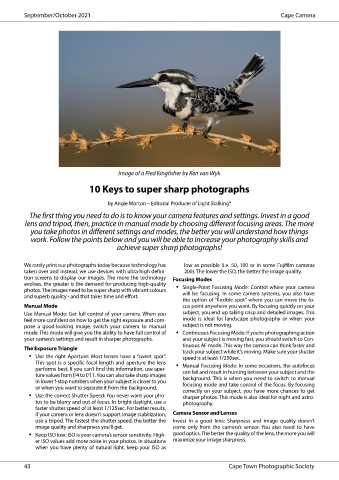
                                           Image of a Pied Kingfisher by Ken van Wyk

                                10 Keys to super sharp photographs


                                       by Angie Morton – Editorial Producer of Light Stalking*
           The first thing you need to do is to know your camera features and settings. Invest in a good
          lens and tripod, then, practice in manual mode by choosing different focusing areas. The more
            you take photos in different settings and modes, the better you will understand how things
            work. Follow the points below and you will be able to increase your photography skills and
                                          achieve super sharp photographs!


          We rarely print our photographs today because technology has   low as possible (i.e. 50, 100 or in some Fujifilm cameras
          taken over and instead, we use devices with ultra-high defini-  200). The lower the ISO, the better the image quality.
          tion screens to display our images. The more the technology   Focusing Modes
          evolves, the greater is the demand for producing high-quality
          photos. The images need to be super sharp with vibrant colours     • Single-Point Focusing Mode: Control where your camera
          and superb quality - and that takes time and effort.   will be focusing. In some camera systems, you also have
                                                                 the option of “flexible spot” where you can move the fo-
          Manual Mode                                            cus point anywhere you want. By focusing quickly on your
          Use Manual Mode: Get full control of your camera. When you   subject, you end up taking crisp and detailed images. This
          feel more confident on how to get the right exposure and com-  mode  is ideal  for landscape  photography  or when your
          pose a good-looking image, switch your camera to manual   subject is not moving.
          mode. This mode will give you the ability to have full control of     • Continuous Focusing Mode: If you’re photographing action
          your camera’s settings and result in sharper photographs.  and your subject is moving fast, you should switch to Con-
          The Exposure Triangle                                  tinuous AF mode. This way the camera can think faster and
                                                                 track your subject while it’s moving. Make sure your shutter
              • Use the right Aperture: Most lenses have a “sweet spot”.   speed is at least 1/250sec.
             This spot is a specific focal length and aperture the lens
             performs best. If you can’t find this information, use aper-    • Manual Focusing Mode: In some occasions, the autofocus
             ture values from f/4 to f/11. You can also take sharp images   can fail and result in hunting between your subject and the
             in lower f-stop numbers when your subject is closer to you   background. This is when you need to switch to manual
             or when you want to separate it from the background.  focusing mode and take control of the focus. By focusing
                                                                 correctly on your subject, you have more chances to get
              • Use the correct Shutter Speed: You never want your pho-  sharper photos. This mode is also ideal for night and astro-
             tos to be blurry and out of focus. In bright daylight, use a   photography.
             faster shutter speed of at least 1/125sec. For better results,
             if your camera or lens doesn’t support image stabilization,   Camera Sensor and Lenses
             use a tripod. The fastest the shutter speed, the better the     Invest in a good lens: Sharpness and image quality doesn’t
             image quality and sharpness you’ll get.          come only from the camera’s sensor. You also need to have
              • Keep ISO low: ISO is your camera’s sensor sensitivity. High-  good optics. The better the quality of the lens, the more you will
             er ISO values add more noise in your photos. In situations   maximize your image sharpness.
             when you have plenty of natural light, keep your ISO as


          43                                                                     Cape Town Photographic Society

