


Page 14 - Cape-Camera-May-2022
P. 14
May 2022                                                                                                                                                                              Cape Camera


            WILL THIS STORY MAKE A GOOD PHOTO ESSAY
            1. Is there a story arc?
            Consider how the story will develop from the beginning
            to the middle and end. Ideally there is a dear conflict and
            a potential resolution.
            2. What Is the fulcrum of the story?
            Is the story centred on something you can see? Or does
            it need to be heard or explained to be best appreciated?
            Like all story mediums, photography has limitations. If a
            story centres on sound or dense explanations, save it for
            radio or written pieces.
            3. Are there opportunities for compelling imagery?
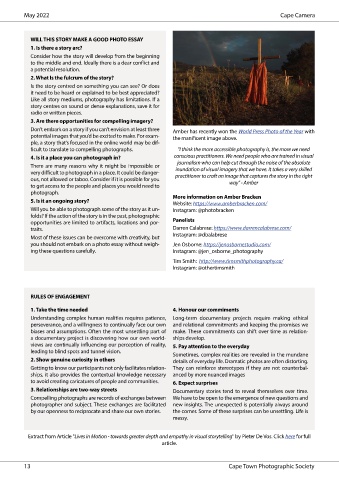
            Don’t embark on a story if you can’t envision at least three   Amber has recently won the World Press Photo of the Year with
            potential images that you’d be excited to make. For exam-  the manificent image above.
            ple, a story that’s focused in the online world may be dif-
            ficult to translate to compelling photographs.     "I think the more accessible photography is, the more we need
            4. Is it a place you can photograph in?           conscious practitioners. We need people who are trained in visual
                                                               journalism who can help cut through the noise of the absolute
            There are many reasons why it might be impossible or   inundation of visual imagery that we have. It takes a very skilled
            very difficult to photograph in a place. It could be danger-  practitioner to craft an image that captures the story in the right
            ous, not allowed or taboo. Consider if it is possible for you         way" - Amber
            to get access to the people and places you would need to
            photograph.                                       More information on Amber Bracken
            5. Is it an ongoing story?
                                                              Website: https://www.amberbracken.com/
            Will you be able to photograph some of the story as it un-  Instagram: @photobracken
            folds? If the action of the story is in the past, photographic
            opportunities are limited to artifacts, locations and por-  Panelists
            traits.                                           Darren Calabrese: https://www.darrencalabrese.com/
            Most of these issues can be overcome with creativity, but   Instagram: @dbalabrese
            you should not embark on a photo essay without weigh-  Jen Osborne: https://jenosbornestudio.com/
            ing these questions carefully.                    Instagram: @jen_osborne_photography
                                                              Tim Smith:  http://www.timsmithphotography.ca/
                                                              Instagram: @othertimsmith


            RULES OF ENGAGEMENT

            1. Take the time needed                           4. Honour our commiments
            Understanding complex human realities requires patience,   Long-term documentary projects require making ethical
            perseverance, and a willingness to continually face our own   and relational commitments and keeping the promises we
            biases and assumptions. Often the most unsettling part of   make. These commitments can shift over time as relation-
            a documentary project is discovering how our own world-  ships develop.
            views are continually influencing our perception of reality,   5. Pay attention to the everyday
            leading to blind spots and tunnel vision.         Sometimes, complex realities are revealed in the mundane
            2. Show genuine curiosity in others               details of everyday life. Dramatic photos are often distorting.
            Getting to know our participants not only facilitates relation-  They can reinforce stereotypes if they are not counterbal-
            ships, it also provides the contextual knowledge necessary   anced by more nuanced images
            to avoid creating caricatures of people and communities.   6. Expect surprises
            3. Relationships are two-way streets              Documentary stories tend to reveal themselves over time.
            Compelling photographs are records of exchanges between   We have to be open to the emergence of new questions and
            photographer and subject. These exchanges are facilitated   new insights. The unexpected is potentially always around
            by our openness to reciprocate and share our own stories.  the corner. Some of these surprises can be unsettling. Life is
                                                              messy.


           Extract from Article "Lives in Motion - towards greater depth and empathy in visual storytelling" by Pieter De Vos. Click here for full
                                                          article.


          13                                                                     Cape Town Photographic Society

