


Page 50 - Cape-Camera-May-June-2021
P. 50
May/June 2021                                                                                                                                                                   Cape Camera


                                Discovering your own creative vision


                                        by Stephen Burgstahler (APSSA, DPSSA, EFIAP, QPSA)

                                  We  join photography  clubs for   Study art and artists, photography and photographers
                                  many reasons: to learn tech-  Become a student of Photography and Art, read books, study
                                  nique, to understand basic com-  the history of Art and Photography, visit galleries and exhibi-
                                  position, to try our camera skill   tions.
                                  with different genres.  There is,
                                  however, a danger of becoming   Evaluate your Silver and Bronze images!
                                  ‘stuck’ in a photography club   Assuming  that  you  were  trying  something  new  or  creative,
                                  paradigm where the focus is   your Silver and Bronze images may be indicative of an attempt
                                  often more about competition   to go beyond the ‘rules’.  What do your Silver and Bronze images
                                  than it is about expressing one-  say about you, your style, tendencies, likes, and passions? Do
                                  self through the medium of pho-  you see any potential creative expressions?
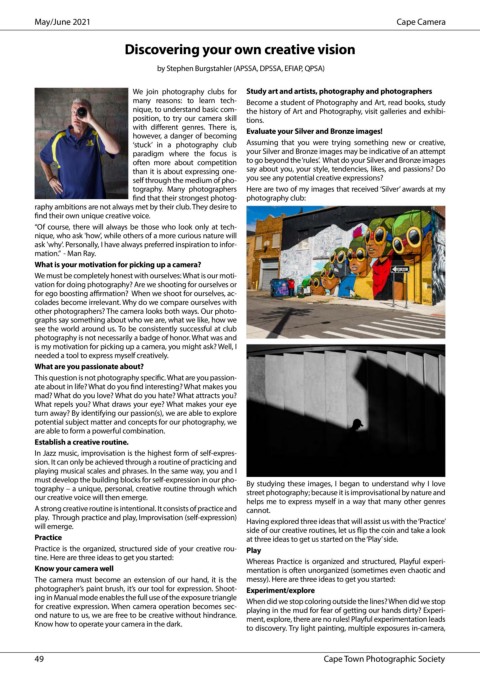
                                  tography. Many photographers   Here are two of my images that received ‘Silver’ awards at my
                                  find that their strongest photog-  photography club:
          raphy ambitions are not always met by their club. They desire to
          find their own unique creative voice.
          “Of course, there will always be those who look only at tech-
          nique, who ask 'how', while others of a more curious nature will
          ask 'why'. Personally, I have always preferred inspiration to infor-
          mation.”  - Man Ray.
          What is your motivation for picking up a camera?
          We must be completely honest with ourselves: What is our moti-
          vation for doing photography? Are we shooting for ourselves or
          for ego boosting affirmation?  When we shoot for ourselves, ac-
          colades become irrelevant. Why do we compare ourselves with
          other photographers? The camera looks both ways. Our photo-
          graphs say something about who we are, what we like, how we
          see the world around us. To be consistently successful at club
          photography is not necessarily a badge of honor. What was and
          is my motivation for picking up a camera, you might ask? Well, I
          needed a tool to express myself creatively.
          What are you passionate about?
          This question is not photography specific. What are you passion-
          ate about in life? What do you find interesting? What makes you
          mad? What do you love? What do you hate? What attracts you?
          What repels you? What draws your eye? What makes your eye
          turn away? By identifying our passion(s), we are able to explore
          potential subject matter and concepts for our photography, we
          are able to form a powerful combination.
          Establish a creative routine.
          In Jazz music, improvisation is the highest form of self-expres-
          sion. It can only be achieved through a routine of practicing and
          playing musical scales and phrases. In the same way, you and I
          must develop the building blocks for self-expression in our pho-  By studying these images, I began to understand why I love
          tography – a unique, personal, creative routine through which   street photography; because it is improvisational by nature and
          our creative voice will then emerge.                helps me to express myself in a way that many other genres
          A strong creative routine is intentional. It consists of practice and   cannot.
          play.  Through practice and play, Improvisation (self-expression)   Having explored three ideas that will assist us with the ‘Practice’
          will emerge.                                        side of our creative routines, let us flip the coin and take a look
          Practice                                            at three ideas to get us started on the ‘Play’ side.
          Practice is the organized, structured side of your creative rou-  Play
          tine. Here are three ideas to get you started:      Whereas Practice is organized and structured, Playful experi-
          Know your camera well                               mentation is often unorganized (sometimes even chaotic and
          The camera must become an extension of our hand, it is the   messy). Here are three ideas to get you started:
          photographer’s paint brush, it’s our tool for expression. Shoot-  Experiment/explore
          ing in Manual mode enables the full use of the exposure triangle   When did we stop coloring outside the lines? When did we stop
          for creative expression. When camera operation becomes sec-  playing in the mud for fear of getting our hands dirty? Experi-
          ond nature to us, we are free to be creative without hindrance.   ment, explore, there are no rules! Playful experimentation leads
          Know how to operate your camera in the dark.
                                                              to discovery. Try light painting, multiple exposures in-camera,


          49                                                                     Cape Town Photographic Society

