


Page 12 - Cape-Camera-Jan-Feb-2022
P. 12
January/February 2022                                                                                                                                                   Cape Camera


          means that practices such as baiting of subjects with a living crea-  No man-made objects
          ture and removal of birds from nests, for the purpose of obtaining
          a photograph, are highly unethical. Under no circumstances may   Nature images are not allowed to contain people or things cre-
          a living creature be placed in a situation where it will be killed, in-  ated by people unless the objects are a necessary part of the na-
          jured or stressed for the purpose of obtaining a photograph. This   ture story. The basic requirement is that any evidence of human
          rule applies regardless of whether or not the creature being killed,   activity in an image MUST be “a necessary part of the Nature
          injured or stressed is visible in the captured image.  story”. A simple way of looking at this is to ask the question: If
                                                              the human element was not present, would there be an image
          Nature or Wildlife                                  that told a nature story? If the answer is “No”, then the human
                                                              element is a necessary part of the nature story – without the
          We often hear the words Nature and Wildlife used to describe   human element there would be no story to capture.
          natural history photography – they are not one and the same –   In other words a waterhole is manmade and if it was not there
          all wildlife images are nature but not all nature is wildlife!   then there would be nowhere for the animals to drink – so it is a
          To be called wildlife, zoological specimens must be “living free   necessary part of the nature story.
          and unrestrained in a natural or adopted habitat of their own   Examples of things that have been created by people or modi-
          choosing”. The subject must not be under any form of restraint   fied by people and are not allowed in nature images include but
          or restriction by humans. Animals in large nature reserves (such   are not limited to: roads, paths, vehicle tracks, signs, vehicles etc.
          as Kruger National Park in South Africa) are suitable wildlife   that are not a necessary part of the nature story.
          subjects. However, animals in zoos, on game farms or in any
          situation where their movement or food supply is controlled by  Can Dance images be entered into the Sports
          humans, are not suitable wildlife subjects. For some wildlife, the   category?
          adopted habitat may be an environment that has been modi-
          fied by humans but the wildlife must be in that location of its
          own free will.
          Zoological subjects (any form of fauna) must not be removed
          from their natural habitat for the purpose of wildlife photogra-
          phy, nor should they be under any form of control or restraint
          by humans. This includes reptiles, amphibians and insects.


                                                              The answer is NO – not in PSSA Salons.
                                                              While our definition appears to allow Dance to be entered in
                                                              the Sports section as Dance is “an active pastime and does in-
                                                              volve physical exertion”, the Board has decided that it will not
                                                              be allowed in the sport section in salons.  There are obviously
                                                              many arguments against this ruling but please be aware that
                                                              you should enter your dance images in the Open category in
                                                              any PSSA Salons.
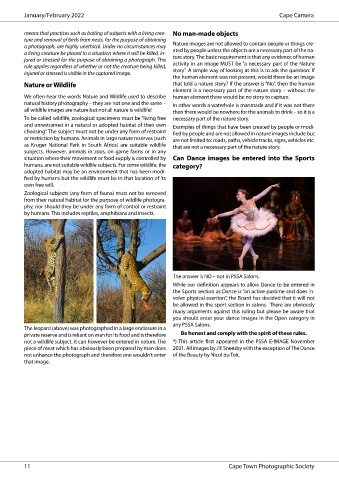
          The leopard (above) was photographed in a large enclosure in a
          private reserve and is reliant on man for its food and is therefore   Be honest and comply with the spirit of these rules.
          not a wildlife subject. It can however be entered in nature. The   *) This article first appeared in the PSSA E-IMAGE November
          piece of meat which has obviously been prepared by man does   2021. All images by Jill Sneesby with the exception of The Dance
          not enhance the photograph and therefore one wouldn’t enter   of the Beauty by Nicol du Toit.
          that image.


          11                                                                     Cape Town Photographic Society

