


Page 35 - Cape-Camera-January-February-2021
P. 35
Cape Camera                                                                                                                                                   January/February 2021


          consciously disregards the rest. Move closer or use a lens to in-   It’s essential to think outside of the box when it comes to crea-
          crease the subject’s size and let it fill the frame. Telephoto lenses   tivity. The composition is one area where it’s necessary to fol-
          are an excellent tool for isolating patterns in distant dunes. Se-  low the rules and know when to push the boundaries to cre-
          lect a camera positioned to isolate the subject from the messy   ate something different. Think in terms of creating different
          or merging background.  Try photographing an object from   perspectives that evoke a mood. It is easy to get tunnel vision
          overhead or from below to isolate the subject. With dunes, get   and become pre-occupied with one style and idea. Try things
          to the highest point above the dunes to give you a dominant   that bring you out of your comfort zone. Do not forget to frame
          perspective. A more elevated view for photographing dunes   both vertically and horizontally and think as well in terms of a
          compresses the scene and includes only what is essential to the   panorama approach. The opposite holds as well, to think small
          image. A low angle of the dunes will enable you to photograph   and look for the finer details. There are no rules for photograph-
          the dunes looking straight up at the sky.           ing dunes, being creative, and remembering to tell a story that
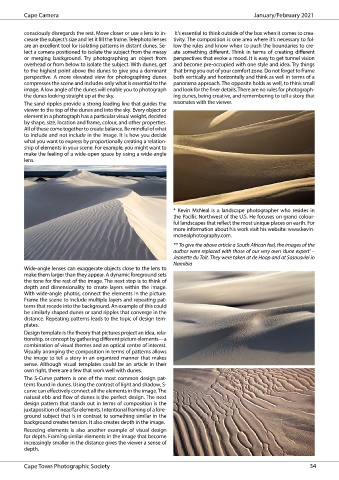
          The sand ripples provide a strong leading line that guides the   resonates with the viewer.
          viewer to the top of the dunes and into the sky. Every object or
          element in a photograph has a particular visual weight, decided
          by shape, size, location and frame, colour, and other properties.
          All of these come together to create balance. Be mindful of what
          to include and not include in the image. It is how you decide
          what you want to express by proportionally creating a relation-
          ship of elements in your scene. For example, you might want to
          make the feeling of a wide-open space by using a wide-angle
          lens.


                                                              * Kevin McNeal is a landscape photographer who resides in
                                                              the Pacific Northwest of the U.S. He focuses on grand colour-
                                                              ful landscapes that reflect the most unique places on earth. For
                                                              more information about his work visit his website: www.kevin-
                                                              mcnealphotography.com.
                                                              ** To give the above article a South African feel, the images of the
                                                              author were replaced with those of our very own ‘dune expert’ –
                                                              Jeanette du Toit. They were taken at de Hoop and at Sosousvlei in
                                                              Namibia
          Wide-angle lenses can exaggerate objects close to the lens to
          make them larger than they appear. A dynamic foreground sets
          the tone for the rest of the image. The next step is to think of
          depth and dimensionality to create layers within the image.
          With wide-angle photos, connect the elements in the picture.
          Frame the scene to include multiple layers and repeating pat-
          terns that recede into the background. An example of this could
          be similarly shaped dunes or sand ripples that converge in the
          distance. Repeating patterns leads to the topic of design tem-
          plates.
          Design template is the theory that pictures project an idea, rela-
          tionship, or concept by gathering different picture elements—a
          combination of visual themes and an optical centre of interest.
          Visually arranging the composition in terms of patterns allows
          the image to tell a story in an organized manner that makes
          sense. Although visual templates could be an article in their
          own right, there are a few that work well with dunes.
          The S-Curve pattern is one of the most common design pat-
          terns found in dunes. Using the contrast of light and shadow, S-
          curve can effectively connect all the elements in the image. The
          natural ebb and flow of dunes is the perfect design. The next
          design pattern that stands out in terms of composition is the
          juxtaposition of near/far elements. Intentional framing of a fore-
          ground subject that is in contrast to something similar in the
          background creates tension. It also creates depth in the image.
          Receding elements is also another example of visual design
          for depth. Framing similar elements in the image that become
          increasingly smaller in the distance gives the viewer a sense of
          depth.

          Cape Town Photographic Society                                                                                                                                                                                                                  34

