


Page 33 - Cape-Camera-January-February-2021
P. 33
Cape Camera                                                                                                                                                   January/February 2021


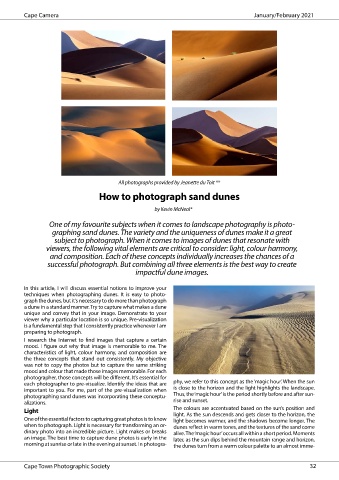
                                           All photographs provided by Jeanette du Toit **

                                    How to photograph sand dunes

                                                       by Kevin McNeal*

                  One of my favourite subjects when it comes to landscape photography is photo-
                   graphing sand dunes. The variety and the uniqueness of dunes make it a great
                    subject to photograph. When it comes to images of dunes that resonate with
                 viewers, the following vital elements are critical to consider: light, colour harmony,
                   and composition. Each of these concepts individually increases the chances of a
                  successful photograph. But combining all three elements is the best way to create
                                                 impactful dune images.

          In this article, I will discuss essential notions to improve your
          techniques when photographing dunes. It is easy to photo-
          graph the dunes, but it’s necessary to do more than photograph
          a dune in a standard manner. Try to capture what makes a dune
          unique and convey that in your image. Demonstrate to your
          viewer why a particular location is so unique. Pre-visualization
          is a fundamental step that I consistently practice whenever I am
          preparing to photograph.
          I research the Internet to find images that capture a certain
          mood. I figure out why that image is memorable to me. The
          characteristics of light, colour harmony, and composition are
          the three concepts that stand out consistently. My objective
          was not to copy the photos but to capture the same striking
          mood and colour that made those images memorable. For each
          photographer, those concepts will be different. It’s essential for
          each photographer to pre-visualize. Identify the ideas that are   phy, we refer to this concept as the ‘magic hour.’ When the sun
          important to you. For me, part of the pre-visualization when   is close to the horizon and the light highlights the landscape.
          photographing sand dunes was incorporating these conceptu-  Thus, the ‘magic hour’ is the period shortly before and after sun-
          alizations.                                         rise and sunset.
          Light                                               The colours are accentuated based on the sun’s position and
                                                              light. As the sun descends and gets closer to the horizon, the
          One of the essential factors to capturing great photos is to know   light becomes warmer, and the shadows become longer. The
          when to photograph. Light is necessary for transforming an or-  dunes reflect in warm tones, and the textures of the sand come
          dinary photo into an incredible picture. Light makes or breaks   alive. The ‘magic hour’ occurs all within a short period. Moments
          an image. The best time to capture dune photos is early in the   later, as the sun dips behind the mountain range and horizon,
          morning at sunrise or late in the evening at sunset. In photogra-  the dunes turn from a warm colour palette to an almost imme-


          Cape Town Photographic Society                                                                                                                                                                                                                  32

