


Page 17 - Cape-Camera-May-June-2021
P. 17
May/June 2021                                                                                                                                                                   Cape Camera

          mony of the building’ history as a prison until 1901.  In late 1961, he was sent by the authorities to the previously
          From an early age Anna showed the determination to succeed   German-owned colonies in Africa, where he identified an op-
          that still characterises her. Aged four, she started participating   portunity to encourage the largest meat processing company
          in gymnastics, which her father coached, and performed so well   in South-West Africa (now Namibia) to export their products
          that she was awarded provincial colours at 14. This was no mean   into Europe.  “However, due to strict import control measures
          feat in a country where the women’s Olympic team had won the   any company that wanted to export into Europa had to have a
          gold medal before the war and finished in the top ten in most of   quality control system in place that required a food technolo-
          the post-war Olympic Games’.                        gist/scientist  and  a  fully  equipped  laboratory.” That  was  not
          Her father, Emil Bach, was a painter and art restorer, mainly of   available in the country.
          Baroque churches. “I didn’t have a particular artistic talent - apart   Prof. Reuter was requested to find a suitable person in Germa-
          from playing the piano,” Anna says modestly. Instead of follow-  ny. “I was delighted when I was offered this challenging posi-
          ing in her father’s footsteps as he wanted her to do, she listened   tion,” says Anna. She was merely 23 at the time, albeit filled with
          to her teacher’s encouragement to study for a degree in natural   an adventurous spirit and a longing to see Africa, about which
          science at the University of Würzburg.              she had read so much. “Three months later I found myself on
          The university was founded in 1402 and its physics department   the Union Castle ship Braemar Castle on the way to Walvisbay,
          became famous in 1895 when Wilhelm Conrad Röntgen, who   where I was greeted by a daunting view of rolling sand dunes
          held the physics chair, discovered X-rays. “He later became the   that stretched endlessly along the horizon.”
          first Nobel Prize winner for Physics in 1901 - donating the entire   The company, however, realised that it could be intimidating
          reward to research at his university,” says Anna.   for such a young girl to arrive in a new country where the vast
          But, in the 1950’s her father didn’t approve of the eldest of his   Namib Desert scenery would be her first impression, and sent
                                                              a company representative on board ship to escort her to the
          three daughters attending a university, however acclaimed   overnight train to Windhoek. Upon arrival she marvelled at the
          it may be. Anna was determined to study and due to the free   blue skies, glorious sunshine and abundance of flouring bou-
          university education offered in Germany and with assistance   gainvillea and the fact that the company had sent a secretary to
          from her mother and godmother to cover other expenses, she   meet her at the station, who took her to a flat they had rented
          enrolled as a student. She supplemented her living expenses by   for her. “What luxury! How could I not fall in love with Namibia?”
          typing lecture notes for students who had missed their classes.  she exclaims.
          In the late 1950’s, the worldwide student activism that dominat-  This love-affair with the country that started when she first saw
          ed university life in the 1960’s, began stirring in German universi-  it in March 1962 is still prevalent in Anna’s photographic work,
          ties. At one of these pro-democracy rallies Anna met Prof Hans   characterised by so many beautiful landscapes. However, her
          Reuter, who encouraged her to change her course to his newly   first day at work almost caused Anna to regret her decision. The
          established Faculty of Food Science and Technology.
                                                              so-called laboratory space in a warehouse was dirty and dusty,
                                                              and the few pieces of equipment were wholly unsuitable to
                                                              be used in a laboratory that was supposed to operate in a hy-
                                                              gienic setting. Fortunately, it did not take long for the company
                                                              to make sure that everything she needed was acquired.  “From
                                                              then on I was very happy and spent the next ten years helping
                                                              to provide all the necessary quality standards to establish a suc-
                                                              cessful export business for the company, and at the same time
                                                              develop numerous products for the local and South African
                                                              markets,” she recounts.
                                                              During those years, she kept in close contact with her professor
                                                              in Germany who continued to be on the forefront of research
                                                              and development in the food industry overseas, particularly in
                                                              the field of packaging, sterilisation and hygiene - keeping Anna
                                                              updated and informed with the help of the latest communica-
                                                              tion tool – a Telex machine! At that time, the only South African
                                                              laboratory that served the food industry was at Metal Box in
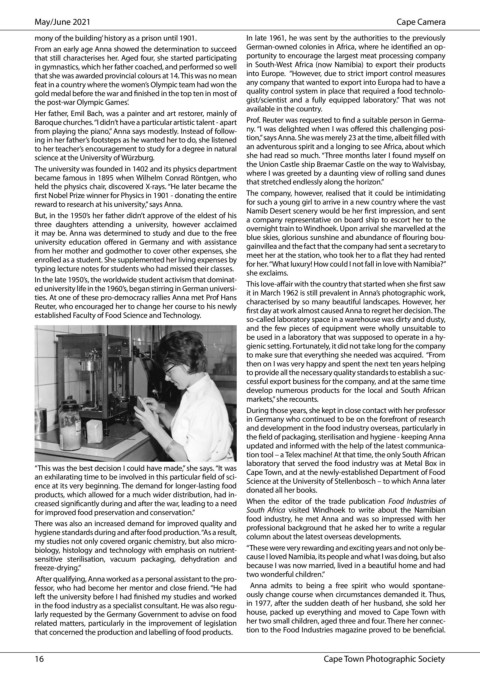
          “This was the best decision I could have made,” she says. “It was   Cape Town, and at the newly-established Department of Food
          an exhilarating time to be involved in this particular field of sci-  Science at the University of Stellenbosch – to which Anna later
          ence at its very beginning. The demand for longer-lasting food   donated all her books.
          products, which allowed for a much wider distribution, had in-
          creased significantly during and after the war, leading to a need   When the editor of the trade publication  Food Industries of
          for improved food preservation and conservation.”   South Africa visited  Windhoek to write about the Namibian
          There was also an increased demand for improved quality and   food industry, he met Anna and was so impressed with her
                                                              professional background that he asked her to write a regular
          hygiene standards during and after food production. “As a result,   column about the latest overseas developments.
          my studies not only covered organic chemistry, but also micro-
          biology, histology and technology with emphasis on nutrient-  “These were very rewarding and exciting years and not only be-
          sensitive sterilisation, vacuum packaging, dehydration and   cause I loved Namibia, its people and what I was doing, but also
          freeze-drying.”                                     because I was now married, lived in a beautiful home and had
           After qualifying, Anna worked as a personal assistant to the pro-  two wonderful children.”
          fessor, who had become her mentor and close friend. “He had    Anna admits to being a free spirit who would spontane-
          left the university before I had finished my studies and worked   ously change course when circumstances demanded it. Thus,
          in the food industry as a specialist consultant. He was also regu-  in 1977, after the sudden death of her husband, she sold her
          larly requested by the Germany Government to advise on food   house, packed up everything and moved to Cape Town with
          related matters, particularly in the improvement of legislation   her two small children, aged three and four. There her connec-
          that concerned the production and labelling of food products.  tion to the Food Industries magazine proved to be beneficial.


          16                                                                     Cape Town Photographic Society

