


Page 18 - Cape-Camera-May-June-2021
P. 18
May/June 2021                                                                                                                                                                   Cape Camera

          She found employment with Thomson Publications (then the   promoted to branch manager two years later.
          largest publisher of trade journals in South Africa) as a stringer   “I gave up my venture into property when I got married again
          for its twelve magazines, became assistant editor of Food Indus-  in 1990 and joined my husband’s publishing company, helping
          tries of South Africa a year later and took over its editorship in   him during the following years to go digital – one of the big-
          1979.                                               gest challenges in my life.” He sold his business in 1996 because
          Fearless of expressing an opinion when she knows she is right,   they wanted to travel extensively, but he sadly fell ill and died
          Anna’s readers were often treated to heated debates between   two years later.
          her science-based views of what the food industry should be   “It was a difficult time and I decided to fill my rather empty life
          doing and the less-scientific commercial views of some indus-  with something meaningful by registering with UNISA to ob-
          try bosses. After the rather sterile laboratory environment, the   tain a BA in art history and history of music, with a few addi-
          publishing world with its eccentric, creative and hard-partying   tional subjects as fillers, such as English literature, poetry and
          journalists and their very casual working hours was a revelation.   ancient history.” By this stage her children had finished univer-
          She loved it!                                       sity and had left home to start their own careers in Johannes-
                                                              burg and overseas.
                                                              She had always been interested in art, history and music. “There
                                                              was no time pressure on me to finish my degree, which allowed
                                                              me to travel frequently to Europe to see what I was studying.
                                                              This included an amazing two months in Florence, Italy where I
                                                              had registered for a course on Renaissance painting, sculpture
                                                              and architecture.
                                                              “Being surrounded by such incredible beauty, I was inspired
                                                              to take up photography in a much more active way than I had
                                                              during my time as editor when I was expected to take many of
                                                              the images that had to go with my articles; or when I was an
                                                              estate agent and had to photograph the houses we were given
                                                              to sell.”
                                                               Her constant companion during that time was her Nikon F5
                                                              with a 50 mm lens. “I still have it today and perhaps one day I
                                                              will take it out of the cupboard, buy some film and try my hand
                                                              in dark room work again – for me still a most exciting part of
                                                              photography that I often miss.”
                                                              But, it took prompting from her son and his loan of a DSLR cam-
          “By this stage, writing had become my passion,” she says. “I thor-  era before Anna ventured into serious photography in 2009. He
          oughly enjoyed starting off with a blank page of white paper   also suggested that she take an introductory course in digital
          every month, waiting for the galley proofs to arrive back from   photography at the Cape Town School of Photography.
          the printer and designing the paste-up pages together with   “This was the spark I needed, particularly when I met some like-
          headlines and photographs, and finally correcting the page   minded and enthusiastic people, including Lesley Parolis and
          proofs before the printed copy of the magazine arrived at my   Kathy Priday, who were all keen to take the acquired knowl-
          desk.                                               edge further after the course had finished.”
          “Those were the days long before digital desk top publishing,
          which has taken away much of the magic and excitement of be-
          ing involved right from the beginning with a blank page to hold-
          ing the finished product in one’s hand!”
          Despite taking the Food Industries publication to new heights,
          Anna’s ascent to the position of managing editor, that every-
          body predicted, was blocked by the company’s policy of not
          promoting females to a senior position and she decided to leave
          in 1983.
          “Although I was offered employment with other publishing
          companies  in Cape  Town and Johannesburg,  I opted  to do
          something completely different, not least of all because I want-
          ed a career where the salary/income was proportionate to my
          work input. I also missed more flexible working hours and a
          more independent work environment to allow me more time
          with my children.”
          A close friend suggested that she become an estate agent, and
          “although this is an occupation without salary or regular income
          and also meant being on call at all hours, working over week-
          ends and having to deal with lots of emotional highs and lows,
          the idea appealed to me regardless.”
          Her confidence got a great boost during her first week as an
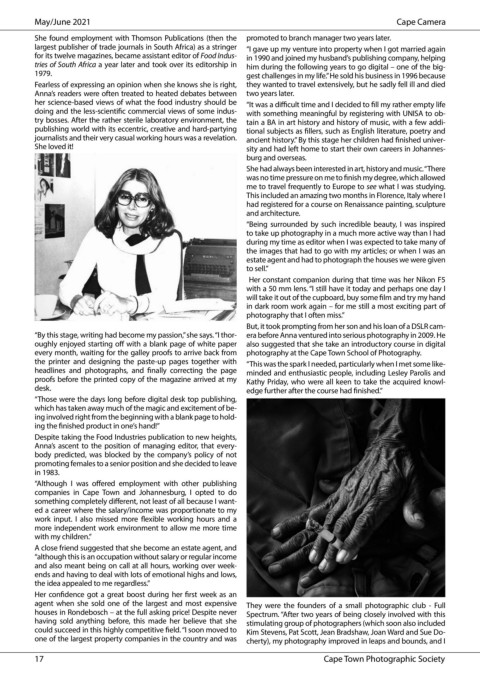
          agent when she sold one of the largest and most expensive   They  were the founders of  a small photographic  club - Full
          houses in Rondebosch – at the full asking price! Despite never   Spectrum. “After two years of being closely involved with this
          having  sold  anything  before,  this  made  her  believe  that  she   stimulating group of photographers (which soon also included
          could succeed in this highly competitive field. “I soon moved to   Kim Stevens, Pat Scott, Jean Bradshaw, Joan Ward and Sue Do-
          one of the largest property companies in the country and was   cherty), my photography improved in leaps and bounds, and I

          17                                                                     Cape Town Photographic Society

