


Page 40 - Cape-Camera-Jan-Feb-2022
P. 40
January/February 2022                                                                                                                                                   Cape Camera


          Photographic Technique

                               Take your best-ever landscape images

                                                     by James Abbott*


          Shooting landscapes is all about capturing the great outdoors
          in ways that show others your vision of the world. Whether aim-
          ing for dramatic light at golden hour or taking a more subdued
          documentary approach to the subject, there’s something for
          everyone in this varied genre of photography. Capturing dra-
          matic light, vivid colour and interesting weather conditions are
          the most popular approach, and this is where we’ll focus our
          attention.
          So, with this idea in mind, here are 40 landscape tips that will
          ultimately help you to develop and improve as a photographer
          to make that 12-inches even more important.
          Some tips may even surprise and excite you in ways that lead to
          a eureka moment where the pieces of the landscape photogra-
          phy puzzle finally fall into place.
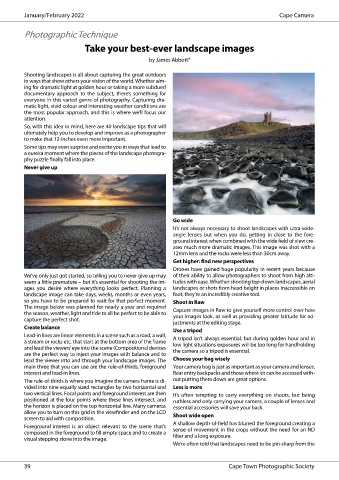
          Never give up


                                                              Go wide
                                                              It’s not always necessary to shoot landscapes with ultra-wide-
                                                              angle lenses but when you do, getting in close to the fore-
                                                              ground interest when combined with the wide field of view cre-
                                                              ates much more dramatic images. This image was shot with a
                                                              12mm lens and the rocks were less than 30cm away.
                                                              Get higher: find new perspectives
                                                              Drones have gained huge popularity in recent years because
          We’ve only just got started, so telling you to never give up may   of their ability to allow photographers to shoot from high alti-
          seem a little premature – but it’s essential for shooting the im-  tudes with ease. Whether shooting top-down landscapes, aerial
          ages you desire where everything looks perfect. Planning a   landscapes or shots from head height in places inaccessible on
          landscape image can take days, weeks, months or even years,   foot, they’re an incredibly creative tool.
          so you have to be prepared to wait for that perfect moment.   Shoot in Raw
          The image below was planned for nearly a year and required
          the season, weather, light and tide to all be perfect to be able to   Capture images in Raw to give yourself more control over how
          capture the perfect shot.                           your images look, as well as providing greater latitude for ad-
                                                              justments at the editing stage.
          Create balance                                      Use a tripod
          Lead-in lines are linear elements in a scene such as a road, a wall,   A tripod isn’t always essential, but during golden hour and in
          a stream or rocks etc. that start at the bottom area of the frame   low light situations exposures will be too long for handholding
          and lead the viewers’ eye into the scene (Compositional devices   the camera so a tripod is essential.
          are the perfect way to inject your images with balance and to
          lead the viewer into and through your landscape images. The   Choose your bag wisely
          main three that you can use are the rule-of-thirds, foreground   Your camera bag is just as important as your camera and lenses.
          interest and lead-in lines.                         Rear entry backpacks and those where kit can be accessed with-
          The rule-of-thirds is where you imagine the camera frame is di-  out putting them down are great options.
          vided into nine equally sized rectangles by two horizontal and   Less is more
          two vertical lines. Focal points and foreground interest are then   It’s often tempting to carry everything on shoots, but being
          positioned at the four points where these lines intersect, and   ruthless and only carrying your camera, a couple of lenses and
          the horizon is placed on the top horizontal line. Many cameras   essential accessories will save your back.
          allow you to turn on this grid in the viewfinder and on the LCD
          screen to aid with composition.                     Shoot wide open
          Foreground interest is an object relevant to the scene that’s   A shallow depth-of-field has blurred the foreground creating a
                                                              sense of movement in the crops without the need for an ND
          composed in the foreground to fill empty space and to create a   filter and a long exposure.
          visual stepping stone into the image.
                                                              We’re often told that landscapes need to be pin-sharp from the


          39                                                                     Cape Town Photographic Society

