


Page 41 - Cape-Camera-Jan-Feb-2022
P. 41
Cape Camera                                                                                                                                                    January/February 2022


          foreground interest all the way to the background.   in changeable weather, the point of change between stormy
          This is indeed the best approach for many scenes, but it’s not   and fine weather can produce some of the most dramatic re-
          the only way and shooting at the maximum aperture of your   sults.
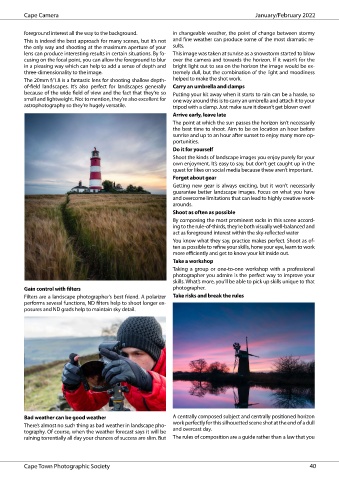
          lens can produce interesting results in certain situations. By fo-  This image was taken at sunrise as a snowstorm started to blow
          cusing on the focal point, you can allow the foreground to blur   over the camera and towards the horizon. If it wasn’t for the
          in a pleasing way which can help to add a sense of depth and   bright light out to sea on the horizon the image would be ex-
          three-dimensionality to the image.                  tremely dull, but the combination of the light and moodiness
          The 20mm f/1.8 is a fantastic lens for shooting shallow depth-  helped to make the shot work.
          of-field landscapes. It’s also perfect for landscapes generally   Carry an umbrella and clamps
          because of the wide field of view and the fact that they’re so   Putting your kit away when it starts to rain can be a hassle, so
          small and lightweight. Not to mention, they’re also excellent for   one way around this is to carry an umbrella and attach it to your
          astrophotography so they’re hugely versatile.       tripod with a clamp. Just make sure it doesn’t get blown over!
                                                              Arrive early, leave late
                                                              The point at which the sun passes the horizon isn’t necessarily
                                                              the best time to shoot. Aim to be on location an hour before
                                                              sunrise and up to an hour after sunset to enjoy many more op-
                                                              portunities.
                                                              Do it for yourself
                                                              Shoot the kinds of landscape images you enjoy purely for your
                                                              own enjoyment. It’s easy to say, but don’t get caught up in the
                                                              quest for likes on social media because these aren’t important.
                                                              Forget about gear
                                                              Getting new gear is always exciting, but it won’t necessarily
                                                              guarantee better landscape images. Focus on what you have
                                                              and overcome limitations that can lead to highly creative work-
                                                              arounds.
                                                              Shoot as often as possible
                                                              By composing the most prominent rocks in this scene accord-
                                                              ing to the rule-of-thirds, they’re both visually well-balanced and
                                                              act as foreground interest within the sky-reflected water
                                                              You know what they say, practice makes perfect. Shoot as of-
                                                              ten as possible to refine your skills, hone your eye, learn to work
                                                              more efficiently and get to know your kit inside out.
                                                              Take a workshop
                                                              Taking a group or one-to-one workshop with a professional
                                                              photographer you admire is the perfect way to improve your
                                                              skills. What’s more, you’ll be able to pick up skills unique to that
          Gain control with filters                           photographer.
          Filters are a landscape photographer’s best friend. A polarizer   Take risks and break the rules
          performs several functions, ND filters help to shoot longer ex-
          posures and ND grads help to maintain sky detail.


          Bad weather can be good weather                     A centrally composed subject and centrally positioned horizon
          There’s almost no such thing as bad weather in landscape pho-  work perfectly for this silhouetted scene shot at the end of a dull
          tography. Of course, when the weather forecast says it will be   and overcast day.
          raining torrentially all day your chances of success are slim. But   The rules of composition are a guide rather than a law that you


          Cape Town Photographic Society                                                                                                                                                                                                                  40

