


Page 9 - Cape-Camera-April-2023
P. 9
Cape Camera                                                                                                                                                                            April 2023

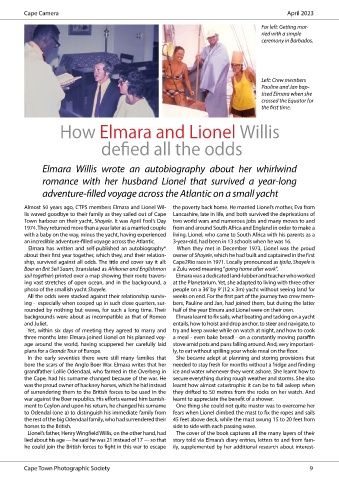
                                                                                             Far left: Getting mar-
                                                                                             ried with a simple
                                                                                             ceremony in Barbados.


                                                                                             Left: Crew members
                                                                                             Pauline and Jan bap-
                                                                                             tised Elmara when she
                                                                                             crossed the Equator for
                                                                                             the first time.


                      How Elmara and Lionel Willis


                                    defied all the odds


                Elmara Willis wrote an autobiography about her whirlwind
                romance with her husband Lionel that survived a year-long

                adventure-filled voyage across the Atlantic on a small yacht


          Almost 50 years ago, CTPS members Elmara and Lionel Wil-  the poverty back home. He married Lionel’s mother, Eva from
          lis waved goodbye to their family as they sailed out of Cape  Lancashire, late in life, and both survived the deprivations of
          Town harbour on their yacht, Shayele. It was April Fool’s Day  two world wars and numerous jobs and many moves to and
          1974. They returned more than a year later as a married couple  from and around South Africa and England in order to make a
          with a baby on the way, minus the yacht, having experienced  living. Lionel, who came to South Africa with his parents as a
          an incredible adventure-filled voyage across the Atlantic.   3-year-old, had been in 13 schools when he was 16.
              Elmara  has  written  and  self-published  an  autobiography*    When they met in December 1973, Lionel was the proud
          about their first year together, which they, and their relation-  owner of Shayele, which he had built and captained in the first
          ship, survived against all odds. The title and cover say it all:  Cape2Rio race in 1971. Locally pronounced as tjaila, Shayele is
          Boer en Brit Seil Saam, (translated as Afrikaner and Englishman   a Zulu word meaning “going home after work”.
          sail together) printed over a map showing their route travers-  Elmara was a dedicated land-lubber and teacher who worked
          ing vast stretches of open ocean, and in the background, a  at the Planetarium. Yet, she adapted to living with three other
          photo of the smallish yacht Shayele.                people on a 36’ by 9’ (12 x 3m) yacht without seeing land for
            All the odds were stacked against their relationship surviv-  weeks on end. For the first part of the journey two crew mem-
          ing -  especially when cooped up in such close quarters, sur-  bers, Pauline and Jan, had joined them, but during the latter
          rounded by nothing but waves, for such a long time. Their  half of the year Elmara and Lionel were on their own.
          backgrounds were about as incompatible as that of Romeo   Elmara learnt to fix sails, what beating and tacking on a yacht
          and Juliet.                                         entails, how to hoist and drop anchor, to steer and navigate, to
           Yet, within six days of meeting they agreed to marry and  try and keep awake while on watch at night, and how to cook
          three months later Elmara joined Lionel on his planned voy-  a meal - even bake bread! - on a constantly moving paraffin
          age around the world, having scuppered her carefully laid  stove amid pots and pans falling around. And, very important-
          plans for a Grande Tour of Europe.                  ly, to eat without spilling your whole meal on the floor.
           In the early seventies there were still many families that   She became adept at planning and storing provisions that
          bore the scars of the Anglo Boer War. Elmara writes that her  needed to stay fresh for months without a fridge and finding
          grandfather Lollie Odendaal, who farmed in the Overberg in  ice and water whenever they went ashore. She learnt how to
          the Cape, had his surname changed because of the war. He  secure everything during rough weather and storms. She also
          was the proud owner of hackney horses, which he hid instead  learnt how almost catastrophic it can be to fall asleep when
          of surrendering them to the British forces to be used in the  they drifted to 50 metres from the rocks on her watch. And
          war against the Boer republics. His efforts earned him banish-  learnt to appreciate the benefit of a shower.
          ment to Ceylon and upon his return, he changed his surname   One thing she could not quite master was to overcome her
          to Odendal (one a) to distinguish his immediate family from  fears when Lionel climbed the mast to fix the ropes and sails
          the rest of the big Odendaal family, who had surrendered their  45 feet above deck, while the mast swung 15 to 20 feet from
          horses to the British.                              side to side with each passing wave.
           Lionel’s father, Henry Wingfield Willis, on the other hand, had   The cover of the book captures all the many layers of their
          lied about his age — he said he was 21 instead of 17 — so that   story told via Elmara’s diary entries, letters to and from fam-
          he could join the British forces to fight in this war to escape   ily, supplemented by her additional research about interest-


          Cape Town Photographic Society                                                                                                                                                                                                                  9

