


Page 17 - Cape-Camera-January-February-2021
P. 17
Cape Camera                                                                                                                                                   January/February 2021


          As the spiritual heart of Lhasa and the holiest house of worship   known for its high academic standards, and has been one of
          in Tibet, the Jokhang Temple is packed with pilgrims eager to   the premier Buddhist universities in Lhasa for centuries.
          prostrate themselves in its courtyards, spin its prayer wheels,   Its pearl-white monastic buildings are unique in their layout
          and chant within its venerable halls. It accepts worshippers   and structure. They are scattered across the hillside and built
          from all branches of Buddhism, and is of great historical signifi-  around the main caves and temples of Jamyang Choge, includ-
          cance and continuing cultural importance. Its main attraction is   ing  the two beautiful pagodas that stand out magnificently
          the life-sized statue of Shakyamuni, together with various other   from the surrounding halls and chapels. From the top of the
          statues of Buddha, exquisite murals and striking architectural   hill, we were treated to a breath-taking view of the city of Lhasa
          features.                                           and the majestic mountains in the distance.
          The temple itself is a four-storey timber structure with a distinc-
          tive golden top. From the main square, one can view the entire
          complex. There are two steles in the square, one recording an
          alliance between the King of Tibet and the Emperor of the Tang
          Dynasty, and the other engraved with hygiene tips on how to
          prevent the spread of smallpox. Even in ancient times, the gov-
          ernment had a way to issue health and safety warnings.


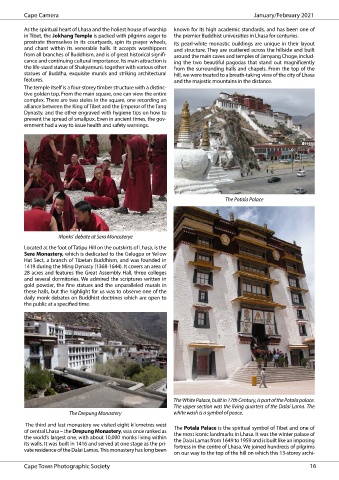
                                                                                The Potala Palace


                      Monks’ debate at Sera Monasterye

          Located at the foot of Tatipu Hill on the outskirts of Lhasa, is the
          Sera Monastery, which is dedicated to the Gelugpa or Yellow
          Hat Sect, a branch of Tibetan Buddhism, and was founded in
          1419 during the Ming Dynasty (1368-1644). It covers an area of
          28 acres and features the Great Assembly Hall, three colleges
          and several dormitories. We admired the scriptures written in
          gold powder, the fine statues and the unparalleled murals in
          these halls, but the highlight for us was to observe one of the
          daily monk debates on Buddhist doctrines which are open to
          the public at a specified time.


                                                              The White Palace, built in 17th Century, is part of the Potala palace.
                                                              The upper section was the living quarters of the Dalai Lama. The
                         The Drepung Monastery                white wash is a symbol of peace.
           The third and last monastery we visited eight kilometres west   The Potala Palace is the spiritual symbol of Tibet and one of
          of central Lhasa – the Drepung Monastery, was once ranked as   the most iconic landmarks in Lhasa. It was the winter palace of
          the world’s largest one, with about 10,000 monks living within   the Dalai Lamas from 1649 to 1959 and is built like an imposing
          its walls. It was built in 1416 and served at one stage as the pri-  fortress in the centre of Lhasa. We joined hundreds of pilgrims
          vate residence of the Dalai Lamas. This monastery has long been
                                                              on our way to the top of the hill on which this 13-storey archi-
          Cape Town Photographic Society                                                                                                                                                                                                                  16

