


Page 6 - Cape-Camera-March-April-2021
P. 6
Cape Camera                                                                                                                                                               March/April 2021


                               Jill Sneesby explains Honours judging

                                                       by Nicol du Toit
                             With 13 Western Cape members being   together and then view each digital image twice individually
                             awarded PSSA Honours in the most   to decide whether it meets the standards to be accepted. The
                             recent judging cycle, there is clearly   last few years they usually evaluated about 100 panels, but this
                             plenty of interest amongst regional   time applicants were given extended time to resubmit panels
                             members to add some titles behind   due to Covid and there were “only” 88 to be evaluated.
                             their names. I therefore decided to ask   With every judging session there will be some panels where
                             the  PSSA  director  responsible  for  the   only a few new images need to be evaluated and they will
          Honours Division, Jill Sneesby, to provide some more informa-  therefore not only be looking at new panels where 10, 15 or 25
          tion about what is required from Honours applicants and the   new images have to be evaluated.
          challenges they should be aware of.                 An image needs the nod of approval of 75% of the judges to
          Please note: all the information about applying for Honours and   pass and if, for example, 9 out of 12 judges say yes, it is awarded
          the requirements for the different levels are available on the   a credit. If it is borderline, for example only 8 of the 12 giving it
          PSSA website under the Honours tab. In addition, a set of videos   a credit, it will be discussed. Below that, the image will not be
          further explaining the Honours process can be viewed here.  discussed and it will fail.
          Twice a year (in February/March and July/August) the Honours   If only one image in the panel is failed (two in the case of a Fel-
          Judging Panel get together to evaluate the panels submitted by   lowship), the applicant will be asked to resubmit a new image
          PSSA members hoping to be awarded a Licentiateship (LPSSA),   that will be judged by all the judges remotely. If it is accepted,
          an Associateship (APSSA) or a Fellowship (FPSSA) of the PSSA.  the applicant will be awarded the Honours.
          This Honours Judging Panel usually consists of 12 wise men and   It is not easy for an applicant to be awarded Honours with the
          women, who must all be currently active, accomplished pho-  first application, although this time 7 of the 37 LPSSA and 3 of
          tographers, who have an FPSSA Honour themselves. There is a   the 29 APSSA Colour applicants were successful on their first
          core of experienced judges, but new judges are welcomed. The   application. Most applicants are asked to submit new images
          judging panel is no closed shop and anyone can apply to be a   for the next judging session to replace those that failed to get
          judge, you don’t have to be asked, explains Jill. That is, as long as   credits – provided that a minimum of 33% of the images passed
          you meet the criteria.                              the first time.  The applicant will keep his/her credits but they
          “The panel must have a good balance with judges from different   are only valid for two years (namely, four judging sessions) and
          regions and representing different genres and styles – some will   if the panel has not been passed in that period, the applicant
          be more inclined to focus more heavily on the technical aspects   must start afresh.
          and some more on the artistic,” she says. “We’ve always said we   Judging process
          wanted to rotate judges – and maybe we do not rotate judges   Salon judges have a few seconds to decide on a score for an
          as often as some people would have liked – but you do need   image, Honours judges do have more time to look at an im-
          consistency. You can’t just have mainly new judges because you   age, but they will be influenced by the first thing they see: what
          want to change.”                                    moves them in the image, or jumps out first. “If this is bad tech-
          While the ideal is to have a panel of 12, sometimes needs dictate   nique, it may override artistic merit,” says Jill. These could be
          that there are fewer. In the most recent judging cycle, for exam-  over-sharpening haloes, noise, too soft focus where it should
          ple, the panel consisted of eight judges because many of the   be sharp, dust spots, etc.
          core group were unavailable, some due to Covid, and Jill didn’t   “All the judges can give their opinions,” explains Jill. “What
          want to include too many newcomers.                 works well is if there is someone on the panel who is strong in
          She was very impressed with the two new judges on the most   a specific field who can point out what they see what others
          recent panel – one of them our own Kim Stevens from CTPS.   might not.” Such an expert can also ask to discuss an image if
          “Ciska (Venter) and Kim participated right from the start,” says   the others missed something and accepted it, or if it had been
          Jill. “They had their own opinions and were not scared to voice   failed where it shouldn’t have been failed.
          them. It doesn’t do anybody any good to have judges who have   Prints are even more unforgiving when it comes to showing
          convictions, but are too scared to say what they see. You must   mistakes and bad techniques. A print panel will be displayed
          feel free to make a comment and must not feel dominated by   as in an art gallery. “If you are going to exhibit the print panel
          people who’ve been there longer.”                   at congress or in any exhibition, the public don’t stand back,
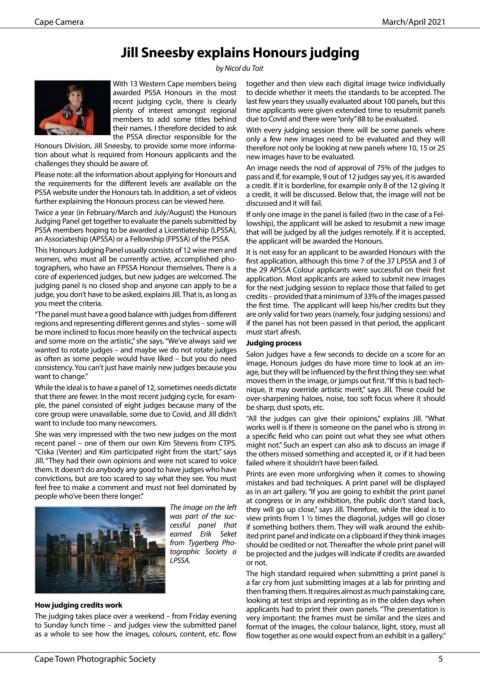
                                           The image on the left   they will go up close,” says Jill. Therefore, while the ideal is to
                                           was part of the suc-  view prints from 1 ½ times the diagonal, judges will go closer
                                           cessful panel that   if something bothers them. They will walk around the exhib-
                                           earned Erik  Seket   ited print panel and indicate on a clipboard if they think images
                                           from  Tygerberg  Pho-  should be credited or not. Thereafter the whole print panel will
                                           tographic  Society a   be projected and the judges will indicate if credits are awarded
                                           LPSSA.             or not.
                                                              The high standard required when submitting a print panel is
                                                              a far cry from just submitting images at a lab for printing and
                                                              then framing them. It requires almost as much painstaking care,
                                                              looking at test strips and reprinting as in the olden days when
          How judging credits work                            applicants had to print their own panels. “The presentation is
          The judging takes place over a weekend – from Friday evening   very important: the frames must be similar and the sizes and
          to Sunday lunch time – and judges view the submitted panel   format of the images, the colour balance, light, story, must all
          as a whole to see how the images, colours, content, etc. flow   flow together as one would expect from an exhibit in a gallery.”

          Cape Town Photographic Society                                                                                                                                                                                                                  5

