


Page 9 - Cape-Camera-March-April-2021
P. 9
Cape Camera                                                                                                                                                               March/April 2021


                                       From a judge’s point of view


                            - A short introduction to evaluating photographic Images

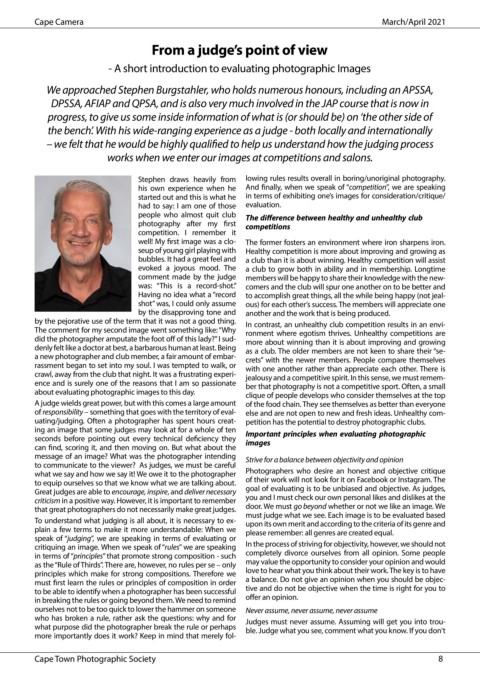
            We approached Stephen Burgstahler, who holds numerous honours, including an APSSA,
              DPSSA, AFIAP and QPSA, and is also very much involved in the JAP course that is now in
             progress, to give us some inside information of what is (or should be) on ‘the other side of
             the bench’. With his wide-ranging experience as a judge - both locally and internationally
            – we felt that he would be highly qualified to help us understand how the judging process
                            works when we enter our images at competitions and salons.


                                   Stephen draws heavily from   lowing rules results overall in boring/unoriginal photography.
                                   his own experience when he   And finally, when we speak of “competition”, we are speaking
                                   started out and this is what he   in terms of exhibiting one’s images for consideration/critique/
                                   had to say: I am one of those   evaluation.
                                   people  who almost  quit  club   The difference between healthy and unhealthy club
                                   photography after my first   competitions
                                   competition. I remember it
                                   well! My first image was a clo-  The former fosters an environment where iron sharpens iron.
                                   seup of young girl playing with   Healthy competition is more about improving and growing as
                                   bubbles. It had a great feel and   a club than it is about winning. Healthy competition will assist
                                   evoked a joyous mood.  The   a club to grow both in ability and in membership. Longtime
                                   comment made by the judge   members will be happy to share their knowledge with the new-
                                   was:  “This is a record-shot.”   comers and the club will spur one another on to be better and
                                   Having no idea what a “record   to accomplish great things, all the while being happy (not jeal-
                                   shot” was, I could only assume   ous) for each other’s success. The members will appreciate one
                                   by the disapproving tone and   another and the work that is being produced.
          by the pejorative use of the term that it was not a good thing.     In contrast, an unhealthy club competition results in an envi-
          The comment for my second image went something like: “Why   ronment where egotism thrives. Unhealthy competitions are
          did the photographer amputate the foot off of this lady?” I sud-  more about winning than it is about improving and growing
          denly felt like a doctor at best, a barbarous human at least. Being   as a club. The older members are not keen to share their “se-
          a new photographer and club member, a fair amount of embar-  crets” with the newer members. People compare themselves
          rassment began to set into my soul. I was tempted to walk, or   with one another rather than appreciate each other. There is
          crawl, away from the club that night. It was a frustrating experi-  jealousy and a competitive spirit. In this sense, we must remem-
          ence and is surely one of the reasons that I am so passionate   ber that photography is not a competitive sport. Often, a small
          about evaluating photographic images to this day.   clique of people develops who consider themselves at the top
          A judge wields great power, but with this comes a large amount   of the food chain. They see themselves as better than everyone
          of responsibility – something that goes with the territory of eval-  else and are not open to new and fresh ideas. Unhealthy com-
          uating/judging. Often a photographer has spent hours creat-  petition has the potential to destroy photographic clubs.
          ing an image that some judges may look at for a whole of ten   Important principles when evaluating photographic
          seconds  before  pointing  out  every  technical  deficiency  they   images
          can find, scoring it, and then moving on. But what about the
          message of an image? What was the photographer intending   Strive for a balance between objectivity and opinion
          to communicate to the viewer?  As judges, we must be careful
          what we say and how we say it! We owe it to the photographer   Photographers who desire an honest and objective critique
          to equip ourselves so that we know what we are talking about.   of their work will not look for it on Facebook or Instagram. The
          Great judges are able to encourage, inspire, and deliver necessary   goal of evaluating is to be unbiased and objective. As judges,
          criticism in a positive way. However, it is important to remember   you and I must check our own personal likes and dislikes at the
          that great photographers do not necessarily make great judges.   door. We must go beyond whether or not we like an image. We
                                                              must judge what we see. Each image is to be evaluated based
          To understand what judging is all about, it is necessary to ex-  upon its own merit and according to the criteria of its genre and
          plain a few terms to make it more understandable: When we   please remember: all genres are created equal.
          speak of “judging”, we are speaking in terms of evaluating or
          critiquing an image. When we speak of “rules” we are speaking   In the process of striving for objectivity, however, we should not
          in terms of “principles” that promote strong composition - such   completely divorce ourselves from all opinion. Some people
          as the “Rule of Thirds”. There are, however, no rules per se – only   may value the opportunity to consider your opinion and would
          principles which make for strong compositions. Therefore we   love to hear what you think about their work. The key is to have
          must first learn the rules or principles of composition in order   a balance. Do not give an opinion when you should be objec-
          to be able to identify when a photographer has been successful   tive and do not be objective when the time is right for you to
          in breaking the rules or going beyond them. We need to remind   offer an opinion.
          ourselves not to be too quick to lower the hammer on someone   Never assume, never assume, never assume
          who has broken a rule, rather ask the questions: why and for   Judges must never assume. Assuming will get you into trou-
          what purpose did the photographer break the rule or perhaps   ble. Judge what you see, comment what you know. If you don't
          more importantly does it work? Keep in mind that merely fol-

          Cape Town Photographic Society                                                                                                                                                                                                                  8

