


Page 7 - Cape-Camera-March-April-2021
P. 7
Cape Camera                                                                                                                                                               March/April 2021


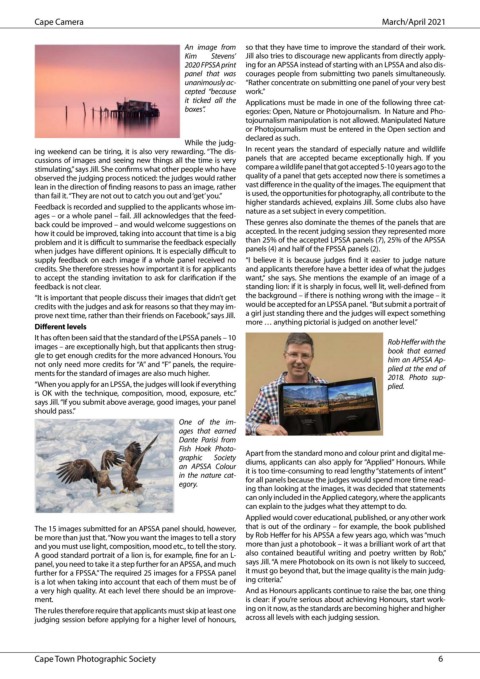
                                               An image from   so that they have time to improve the standard of their work.
                                               Kim   Stevens’  Jill also tries to discourage new applicants from directly apply-
                                               2020 FPSSA print   ing for an APSSA instead of starting with an LPSSA and also dis-
                                               panel that was   courages people from submitting two panels simultaneously.
                                               unanimously ac-  “Rather concentrate on submitting one panel of your very best
                                               cepted “because   work.”
                                               it ticked all the   Applications must be made in one of the following three cat-
                                               boxes”.        egories: Open, Nature or Photojournalism.  In Nature and Pho-
                                                              tojournalism manipulation is not allowed. Manipulated Nature
                                                              or Photojournalism must be entered in the Open section and
                                                              declared as such.
                                               While the judg-
          ing weekend can be tiring, it is also very rewarding. “The dis-  In recent years the standard of especially nature and wildlife
          cussions of images and seeing new things all the time is very   panels that are accepted became exceptionally high. If you
          stimulating,” says Jill. She confirms what other people who have   compare a wildlife panel that got accepted 5-10 years ago to the
          observed the judging process noticed: the judges would rather   quality of a panel that gets accepted now there is sometimes a
          lean in the direction of finding reasons to pass an image, rather   vast difference in the quality of the images. The equipment that
          than fail it. “They are not out to catch you out and ‘get’ you.”  is used, the opportunities for photography, all contribute to the
          Feedback is recorded and supplied to the applicants whose im-  higher standards achieved, explains Jill. Some clubs also have
          ages – or a whole panel – fail. Jill acknowledges that the feed-  nature as a set subject in every competition.
          back could be improved – and would welcome suggestions on   These genres also dominate the themes of the panels that are
          how it could be improved, taking into account that time is a big   accepted. In the recent judging session they represented more
          problem and it is difficult to summarise the feedback especially   than 25% of the accepted LPSSA panels (7), 25% of the APSSA
          when judges have different opinions. It is especially difficult to   panels (4) and half of the FPSSA panels (2).
          supply feedback on each image if a whole panel received no   “I believe it is because judges find it easier to judge nature
          credits. She therefore stresses how important it is for applicants   and applicants therefore have a better idea of what the judges
          to accept the standing invitation to ask for clarification if the   want,“ she says. She mentions the example of an image of a
          feedback is not clear.                              standing lion: if it is sharply in focus, well lit, well-defined from
          “It is important that people discuss their images that didn’t get   the background – if there is nothing wrong with the image – it
          credits with the judges and ask for reasons so that they may im-  would be accepted for an LPSSA panel.  “But submit a portrait of
          prove next time, rather than their friends on Facebook,” says Jill.  a girl just standing there and the judges will expect something
          Different levels                                    more … anything pictorial is judged on another level.”

          It has often been said that the standard of the LPSSA panels – 10                      Rob Heffer with the
          images – are exceptionally high, but that applicants then strug-                       book that earned
          gle to get enough credits for the more advanced Honours. You                           him an APSSA Ap-
          not only need more credits for “A” and “F” panels, the require-                        plied at the end of
          ments for the standard of images are also much higher.                                 2018. Photo sup-
          “When you apply for an LPSSA, the judges will look if everything                       plied.
          is OK with the technique, composition, mood, exposure, etc.”
          says Jill. “If you submit above average, good images, your panel
          should pass.”
                                             One of the im-
                                             ages that  earned
                                             Dante Parisi from
                                             Fish Hoek Photo-  Apart from the standard mono and colour print and digital me-
                                             graphic  Society  diums, applicants can also apply for “Applied” Honours. While
                                             an APSSA Colour   it is too time-consuming to read lengthy “statements of intent”
                                             in the nature cat-  for all panels because the judges would spend more time read-
                                             egory.
                                                              ing than looking at the images, it was decided that statements
                                                              can only included in the Applied category, where the applicants
                                                              can explain to the judges what they attempt to do.
                                                              Applied would cover educational, published, or any other work
          The 15 images submitted for an APSSA panel should, however,   that is out of the ordinary – for example, the book published
          be more than just that. “Now you want the images to tell a story   by Rob Heffer for his APSSA a few years ago, which was “much
          and you must use light, composition, mood etc., to tell the story.   more than just a photobook – it was a brilliant work of art that
          A good standard portrait of a lion is, for example, fine for an L-  also contained beautiful writing and poetry written by Rob,”
          panel, you need to take it a step further for an APSSA, and much   says Jill. “A mere Photobook on its own is not likely to succeed,
          further for a FPSSA.” The required 25 images for a FPSSA panel   it must go beyond that, but the image quality is the main judg-
          is a lot when taking into account that each of them must be of   ing criteria.”
          a very high quality. At each level there should be an improve-  And as Honours applicants continue to raise the bar, one thing
          ment.                                               is clear: if you’re serious about achieving Honours, start work-
          The rules therefore require that applicants must skip at least one   ing on it now, as the standards are becoming higher and higher
          judging session before applying for a higher level of honours,   across all levels with each judging session.


          Cape Town Photographic Society                                                                                                                                                                                                                  6

